How to Bet on UFC Fights in the UK: The Complete Analytical Guide
 Available in US
By UFC Betting Analyst

- Why UFC Betting Has Become the UK’s Fastest-Growing Fight Market
- The Numbers That Shape Every UFC Wager
- Is UFC Betting Legal in the UK? UKGC Framework Explained
- How UFC Odds Work: Fractional, Decimal, and Moneyline Formats
- Every UFC Bet Type Explained — From Moneyline to Method of Victory
- How to Place Your First UFC Bet: Step-by-Step
- UK Bookmakers for UFC: What to Look For
- UFC Betting Strategy at a Glance: Where the Edge Hides
- Live UFC Betting: How In-Play Markets Change the Game
- Betting Integrity in MMA: What UK Punters Should Know
- Responsible Gambling: Tools and Limits That Matter
- Frequently Asked Questions About UFC Betting in the UK
Why UFC Betting Has Become the UK’s Fastest-Growing Fight Market
Nine years ago, when I started tracking MMA odds full-time, telling a fellow analyst you specialised in UFC betting drew blank stares. Football, horse racing, cricket — those were the respectable markets. Combat sports were a rounding error on the bookmaker’s balance sheet, something the trading desks priced as an afterthought between Premier League fixtures. That world is gone.
The global MMA betting handle hit $10.3 billion in 2024, climbing 17% in a single year. UFC’s gross gaming revenue has grown at an estimated compound annual rate above 18% over the past five years — faster, in percentage terms, than any other major sport. “The fighters draw the crowd. Technology captures the revenue,” as one industry analysis put it, and the numbers back that claim without reservation. While UK remote betting generated GGY of £2.6 billion in the 2024-25 financial year — a 10.9% rise — it is combat sports, and UFC in particular, that is pulling the growth curve steepest.
UK gambling industry GGY reached £16.8 billion for April 2024 to March 2025, a 7.3% increase year on year, according to the Gambling Commission’s annual figures. Remote casino, betting and bingo alone accounted for £7.8 billion — up 13.1%. The online channel is not merely growing; it is absorbing the market.
What changed? Three forces converged. First, the UFC’s event calendar is relentless — 43 live cards a year, no off-season, content every single weekend. Second, the audience skews young and digitally native: 52% of Gen Z now identify as UFC or MMA fans, and over 72% of the most engaged viewers are male — precisely the demographic that drives sportsbook sign-ups. Third, the betting product itself evolved. Live micro-markets for significant strikes, takedown attempts, and round-by-round action transformed UFC from a niche offering to a data-rich playground that bookmakers actively promote.
This guide exists because the top ten search results for UFC betting in the UK share a common flaw: they list bookmakers, quote bonus codes, and move on. None of them tell you that favourites won 72% of bouts in 2024 but that blindly backing them still loses money. None break down finish rates by weight class, or walk you through the integrity questions every serious punter should consider before placing a wager.
I have spent nearly a decade building models around fight outcomes, tracking line movements, and identifying where the market misprices fighters. This is the guide I wish someone had handed me in 2017 — analytical, data-backed, and honest about both the opportunities and the risks of betting on the world’s fastest-growing combat sport.
On major UFC fight nights, DraftKings and FanDuel report that UFC events generate 11% of all live-bet clicks — rivalling mid-tier football leagues for in-play engagement despite being a single-organisation sport.
The Numbers That Shape Every UFC Wager
- UFC betting is fully legal in the UK under UKGC regulation — no special licence required for combat sports, and punters pay no tax on winnings.
- The global MMA betting handle reached $10.3 billion in 2024, with UFC GGR growing at an 18%+ compound annual rate — faster than any other major sport.
- Favourites won 72% of UFC bouts in 2024, but blindly backing them is unprofitable because the odds already price in that edge. Value lives in the gap between implied probability and your own assessment.
- Weight class matters enormously: heavyweight finishes hit 65%, while lower divisions trend heavily toward decisions. The overall finish rate fell to a decade-low 45% in 2024.
- Integrity concerns are real — 300 suspicious betting alerts were issued across sports in 2025, with MMA flagged in North America. Check for unusual line movements before wagering on undercard bouts.
Is UFC Betting Legal in the UK? UKGC Framework Explained
I still get emails from readers asking whether betting on cage fighting is actually allowed in Britain. The question is more reasonable than it sounds — combat sports carry a different cultural weight than football or tennis, and the regulatory history is tangled enough that confusion lingers. So let me be direct: UFC betting is fully legal in the United Kingdom, regulated under the same framework that governs every other sport you can wager on.
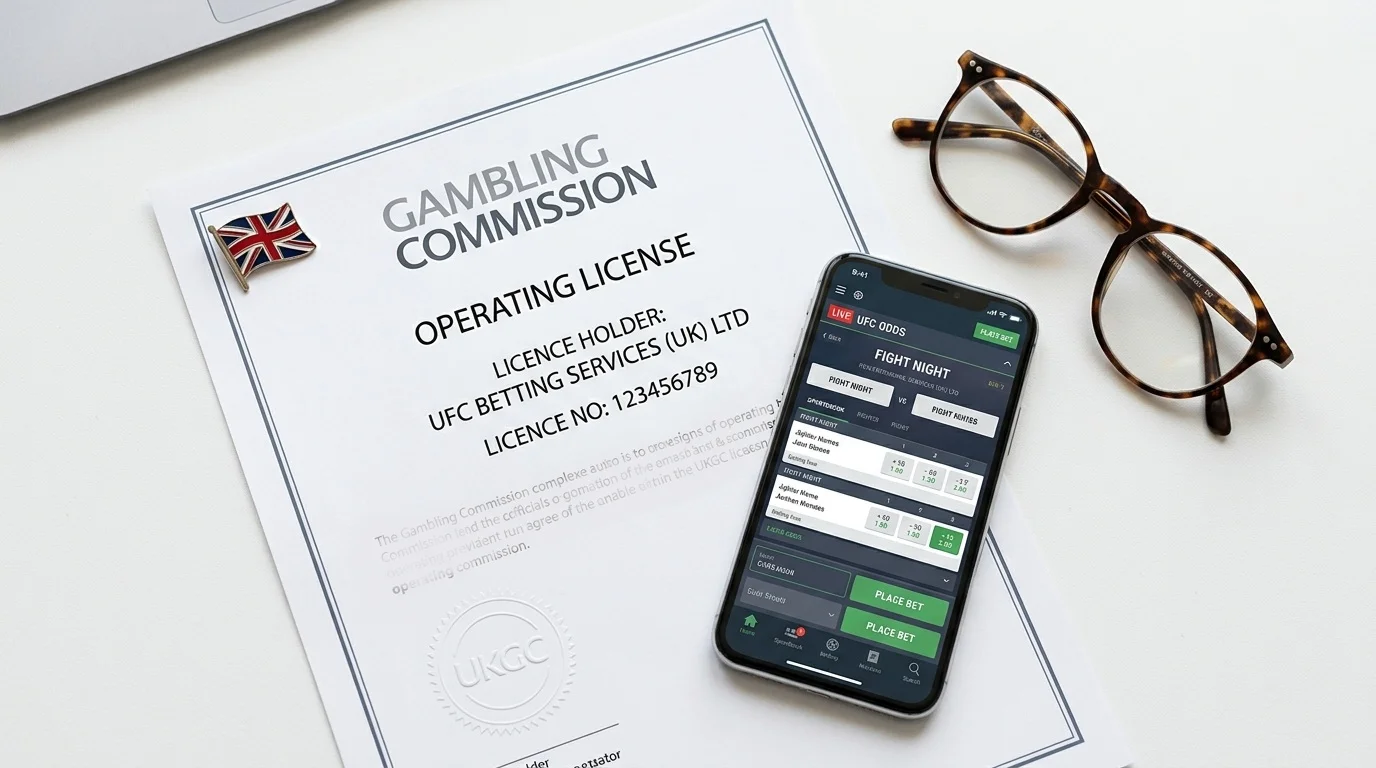
The UK Gambling Commission (UKGC) licences and regulates all commercial gambling activity in Great Britain under the Gambling Act 2005. Any bookmaker offering UFC markets to UK customers must hold a valid UKGC licence. As of March 2025, there were 5,825 licensed betting premises in Britain — a number that has fallen 1.8% year on year as the market shifts online — but the remote sector is booming.
The UKGC does not distinguish between sports when it comes to licensing. A sportsbook licensed to offer football markets can offer UFC markets under the same licence, provided it meets the Commission’s conditions on fair pricing, responsible gambling provisions, and anti-money-laundering protocols. There is no separate “combat sports” approval tier. UFC sits alongside rugby, darts, and horse racing in the Commission’s regulatory scope.
What matters to you as a punter is practical: before you deposit a penny, verify the operator’s licence. Every UKGC-licensed bookmaker displays its licence number in the footer of its website — usually a six-digit number you can cross-reference on the Gambling Commission’s public register. If the number is not there, or the register returns no result, walk away. Unlicensed operators cannot offer the dispute resolution, self-exclusion tools, or segregated-funds protections that the UKGC mandates.
18+ only. All gambling in the UK requires you to be at least 18 years old. Bookmakers are legally obliged to verify your age and identity before allowing you to withdraw funds — and increasingly before you can even place a bet. This is not a formality; operators face significant fines for failures in age verification.
One question I hear repeatedly: do I pay tax on UFC winnings? No. The UK abolished betting duty on punters in 2001. Bookmakers pay a tax on their gross profits, but you as the bettor pay nothing on winnings. Your £500 return on a UFC moneyline is £500 in your pocket.
For a deeper look at licensing, permitted markets, and self-exclusion rights, the Gambling Commission’s public register is the definitive source for verifying any operator.
With the legal ground clear, the next question is mechanical: how do the numbers on the screen actually translate into money?
How UFC Odds Work: Fractional, Decimal, and Moneyline Formats
The first UFC fight I ever bet on, I stared at the odds for a solid five minutes trying to figure out what 4/7 actually meant in cash terms. I had a vague sense the fighter was favoured, but whether I was risking £7 to win £4 or the other way around — no idea. If you have ever felt that confusion, this section will fix it permanently.
UK sportsbooks display UFC odds in three formats: fractional, decimal, and American (moneyline). They all express the same underlying probability, just through different lenses. Understanding all three matters because you will encounter each one — fractional on traditional UK platforms, decimal on European-facing sites, and American whenever you read analysis from the US, which dominates UFC media coverage.
Fractional Odds
Fractional odds — displayed as two numbers separated by a slash (e.g., 5/2), they tell you how much profit you win relative to your stake. A price of 5/2 means £5 profit for every £2 staked, plus your stake back. Total return: £7 on a £2 bet.
Fractional odds are the traditional UK format. When a fighter is listed at 1/4, they are a heavy favourite — you risk £4 to win just £1 profit. At 3/1, the fighter is an underdog — your £1 stake returns £3 profit plus the original pound. The number on the left is always the profit; the number on the right is always the stake.
Example: Fractional odds on a UFC main event
Fighter A: 2/7 (heavy favourite)
Fighter B: 3/1 (underdog)
A £70 bet on Fighter A at 2/7 returns £70 + £20 profit = £90 total.
A £10 bet on Fighter B at 3/1 returns £10 + £30 profit = £40 total.
Decimal Odds
Decimal odds — a single number (e.g., 1.80) representing the total return per £1 staked, including the stake itself. To calculate profit, subtract 1. A price of 1.80 means £0.80 profit per £1 wagered.
Decimal format is simpler for quick mental arithmetic. Multiply your stake by the decimal price, and you have your total return — no fractions to parse. A fighter at 2.50 returns £25 on a £10 bet (£10 x 2.50). A fighter at 1.25 returns £12.50 on the same stake. Many experienced bettors prefer decimals because comparing two prices is instant: 2.50 versus 2.40 — you see immediately which pays more.
American (Moneyline) Odds
Moneyline odds — the American format uses positive and negative numbers. A negative number (e.g., -250) tells you how much you must risk to win £100. A positive number (e.g., +200) tells you how much profit a £100 stake returns. The favourite always carries the minus sign.

American odds dominate UFC discussion because the sport’s heartland is the United States. When you read a pre-fight breakdown that says a fighter is -300, that means staking £300 to win £100 profit. At +250, you stake £100 to win £250 profit. The gap between the two numbers on any given fight reflects the bookmaker’s margin — and in UFC, favourites have won 72% of bouts over recent years, which is why you see heavily negative lines more often than in many other sports.
Converting Between Formats
You do not need to memorise conversion formulas if you use a single format consistently, but knowing the logic helps. Fractional to decimal: divide the fraction and add 1 (5/2 becomes 2.5 + 1 = 3.50). Decimal to fractional: subtract 1 and express as a fraction (3.50 becomes 5/2). American to decimal: for negative lines, divide 100 by the absolute value and add 1 (-250 becomes 1.40); for positive lines, divide by 100 and add 1 (+200 becomes 3.00).
The real skill is recognising implied probability. A price of 1.40 decimal implies a 71.4% win chance (1 / 1.40). If your analysis says the fighter wins 80% of the time, the bet has positive expected value. If your analysis says 65%, the price is too short. That gap between the bookmaker’s implied probability and your assessed probability is where every profitable bet lives. I explore overround calculations and real fight examples in my full breakdown of UFC betting odds.
Once you can read the price, the next step is understanding what exactly you are pricing — and UFC offers far more betting markets than a simple pick-the-winner.
Every UFC Bet Type Explained — From Moneyline to Method of Victory
A colleague once told me that betting on UFC with only the moneyline is like going to a restaurant and only ordering bread. It fills you up, but you are ignoring the entire menu. He was right. The modern UFC betting card at a well-stocked UK sportsbook offers a dozen or more market types per fight — and understanding what each one measures is the difference between punting and analysis.
Moneyline (Match Winner)
Moneyline — a straight bet on which fighter wins the bout, regardless of method or round. The simplest UFC wager and the most liquid market.
The moneyline is where most people start, and for good reason: pick the winner, collect the payout. But simplicity has a cost. Heavy favourites require large stakes for modest returns, and the favourite’s historical edge is already baked into the odds — the upsets that do occur erode whatever thin margin remains.
Method of Victory
Method of victory — a bet on how the fight ends: KO/TKO, submission, or decision (unanimous, split, or majority). Some sportsbooks break this further into fighter-specific method markets — for example, Fighter A by KO/TKO.
This is where the analytical bettor earns their edge. Not every fighter ends bouts the same way, and not every division trends toward the same finish type. In the heavyweight division, roughly 65% of fights end early — KO/TKO dominates, with decision accounting for just 28.6% of outcomes, the lowest of any weight class. Drop down to flyweight or bantamweight, and the decision rate climbs sharply. Pricing a method of victory bet without understanding these divisional splits is guesswork.
Heavyweight
~65% early finish, KO/TKO dominant, decision only ~28.6%
Lightweight and below
Higher decision rates, submissions more competitive, KO/TKO less frequent
Overall UFC (2024)
45% finish rate — the lowest in a decade, rising decision trend
Over/Under Rounds
Over/under rounds — a bet on whether the fight will last longer or shorter than a specified round threshold, usually 1.5 or 2.5 rounds for a 3-round bout, or 2.5 or 3.5 for a 5-round championship fight.
Approximately 41% of men’s UFC bouts finish inside 2.5 rounds, which means the over/under line at 2.5 is roughly a coin flip in aggregate — but it varies wildly by matchup. Two pressure wrestlers grinding out position work will almost always go over. Two power punchers with high knockout rates will trend under. The key is matchup-specific analysis, not league-wide averages.
Exact Round Betting
Exact round — a bet on the specific round in which the fight ends. Higher risk, higher reward. Prices for exact round bets are typically much longer than method or over/under lines because you are predicting not just the outcome but its timing.
Same-Game Parlays and Bet Builders
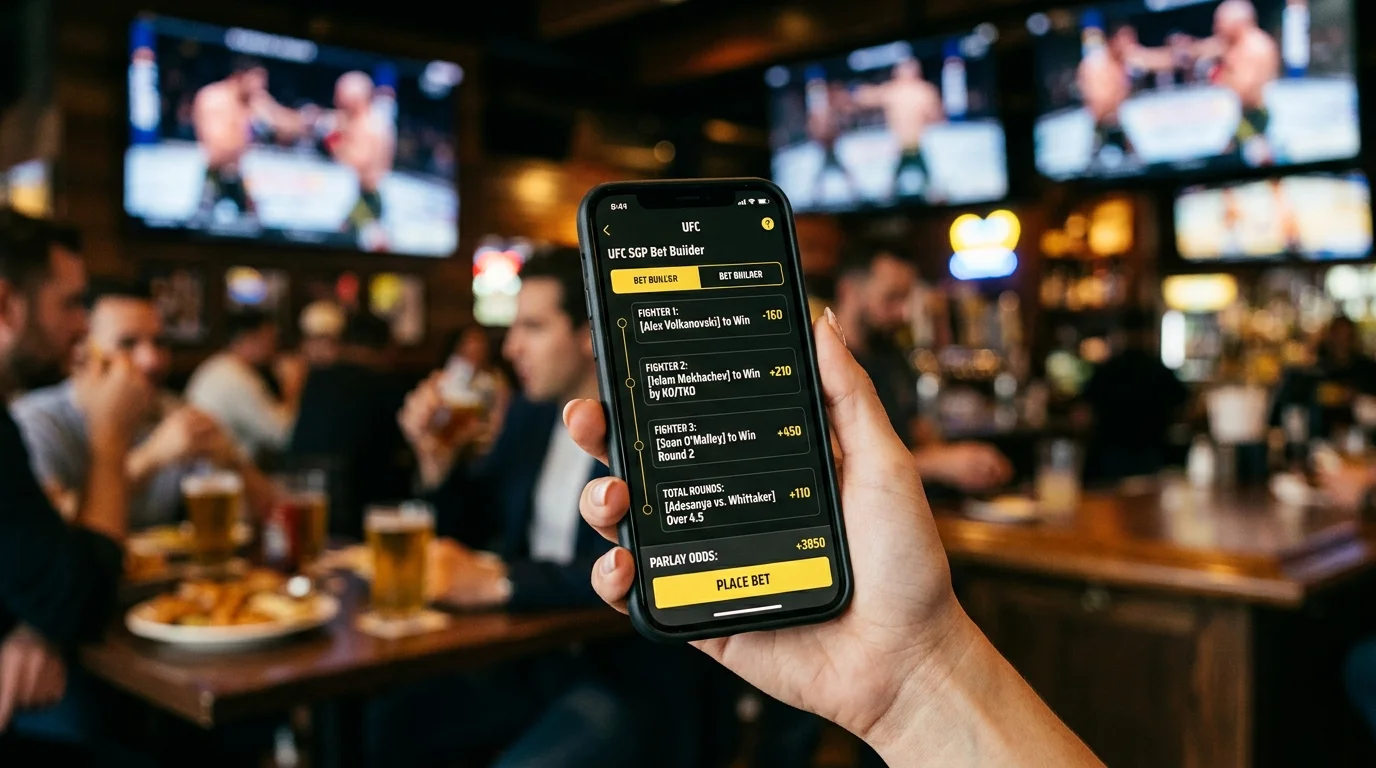
Same-game parlay (bet builder) — a single wager combining multiple selections from the same fight. For example: Fighter A to win by KO/TKO in rounds 1-2, combined with the under 2.5 rounds line. All legs must win for the bet to pay out.
Bet builders have exploded in popularity on UFC fight nights. The appeal is obvious — construct a specific fight narrative and get a juicy combined price. The trap is less obvious: correlated legs (Fighter A by KO naturally correlates with under 2.5 rounds) are sometimes restricted, and the bookmaker’s margin compounds across every leg. One miscalculation and the entire bet falls apart.
Prop Bets
Prop bets (proposition bets) — wagers on specific occurrences within a fight that do not necessarily relate to the final result. Examples include total significant strikes over/under, fight to go the distance (yes/no), and whether a specific fighter will score a knockdown.
The prop market is where UFC betting becomes genuinely interesting for data-driven punters. The UFC Event Centre delivers 50+ real-time statistics per bout, and the range of available props has widened enormously: significant strike totals, takedown attempts, and even clinch time can now be wagered on at select sportsbooks, turning every round into a market of its own.
Example: Method of victory pricing on a hypothetical heavyweight bout
Fighter A by KO/TKO: 6/4
Fighter A by submission: 12/1
Fighter A by decision: 7/2
Fighter B by KO/TKO: 5/1
Fighter B by submission: 8/1
Fighter B by decision: 7/1
Draw: 66/1
Notice how the KO/TKO prices are shortest for both fighters in a heavyweight context — the market reflecting the division’s high finish rate. A sharp bettor asks: do these prices accurately reflect each fighter’s specific finishing ability, or are they just tracking the division average?
Knowing what you can bet on is half the equation. The other half is the practical mechanics of actually placing that wager.
How to Place Your First UFC Bet: Step-by-Step
My first ever UFC bet took me forty minutes to place — not because the process was complicated, but because I second-guessed every click. If that sounds familiar, this section strips the mechanics down to their essentials.
Before you place your first UFC bet
- Confirm the sportsbook holds a valid UKGC licence (check the footer for the licence number and cross-reference on the Gambling Commission’s register).
- Complete identity verification — most operators require a photo ID and proof of address before you can deposit or withdraw.
- Set a deposit limit before funding your account. Every UKGC-licensed operator must offer this tool. Use it. Decide your total budget before emotion enters the equation.
- Familiarise yourself with the sportsbook’s UFC section — navigate to it before a fight card goes live so you know where the markets sit.
- Check the event schedule. UFC typically runs cards on Saturday evenings UK time, with preliminary bouts starting in the late afternoon and the main card from around 1:00 AM for US-based events, or earlier for European and Middle Eastern cards.
The actual placement is straightforward. Open the sportsbook, navigate to the UFC or MMA section, select the event, choose your fight, and click the odds for the market you want. This adds the selection to your bet slip. Enter your stake, review the potential return displayed on the slip, and confirm. The entire process from login to confirmed bet takes under sixty seconds once you know the layout.
Worked example: placing a method of victory bet
You want to back Fighter A by KO/TKO at decimal odds of 2.60.
Step 1: Navigate to the fight card and select the “Method of Victory” market.
Step 2: Click “Fighter A by KO/TKO” — the selection appears in your bet slip at 2.60.
Step 3: Enter your stake: £20.
Step 4: The slip shows potential return: £20 x 2.60 = £52.00 (£32.00 profit + £20.00 stake).
Step 5: Click “Place Bet.” The wager is confirmed and appears in your open bets.
Two things I wish someone had told me early on. First, odds can change between the moment you add a selection and the moment you confirm — especially close to fight time. Most sportsbooks let you choose whether to accept price changes automatically or be notified first; I always opt for notification. Second, check your bet history after confirming. I have seen bets placed on the wrong fighter because the screen layout confused things on mobile. A five-second review saves genuine regret.
You now know what you can bet on and how to place the wager. The next question is subtler: what should you look for in the bookmaker itself?
UK Bookmakers for UFC: What to Look For
In March 2026, the UFC announced that bet365 had replaced DraftKings as the organisation’s Official Sports Betting Partner in the US and Canada. Trip Stoddard, bet365’s Head of Development, called the deal “a defining moment” that reflected “UFC’s always-on event calendar and highly engaged global fanbase.” For UK punters, this kind of headline matters less than what goes on behind the scenes — but it signals where the industry’s attention and investment are flowing, and it is flowing toward MMA.
I am not going to rank bookmakers or tell you which operator is “best.” That kind of list dates itself the moment a bonus expires or a margin shifts. What I can give you is a framework — measurable criteria that separate a sportsbook worth using for UFC from one that bolted MMA onto its offering as an afterthought.
The bet365-UFC partnership replaced a five-year DraftKings deal worth a reported $350 million — the largest sportsbook sponsorship in American combat sports history by annual value. Nicholas Smith, TKO’s Senior Vice President for Global Partnerships, said bet365 “understands fight fans and how they engage with the sport in real time.” Whether or not that translates into a better product for UK bettors depends on market depth, pricing, and execution — not press releases.
Six Criteria That Actually Matter
| Criterion | What to check |
|---|---|
| Market depth | Does the sportsbook offer method of victory, exact round, round groups, fighter props, and same-game parlays for UFC? Or only moneyline and over/under? A well-stocked UFC card should carry 15+ markets per main-card fight. |
| Odds margins | Compare the implied probability across both fighters — the total should be as close to 100% as possible. Margins above 6-7% on UFC events are expensive. Some operators price UFC tighter than others. |
| Preliminary card coverage | Many sportsbooks offer full markets for the main card but thin out or skip early prelims entirely. If you find value in less-covered fights, you need an operator that prices the full card. |
| Live betting quality | Does the operator offer in-play markets during the fight? How quickly do odds update between rounds? Is cash-out available on live UFC wagers? |
| Mobile experience | UFC fight nights run late in UK time zones. You will be betting on your phone. How many taps does it take to navigate to a UFC market, place a bet, and confirm? Test it before a major card. |
| Withdrawal speed | How long from requesting a withdrawal to seeing the money in your account? Some operators process in hours; others take days. For a market where your edge might be thin, tying up capital erodes returns. |

With events running nearly every weekend — numbered pay-per-view cards and Fight Night events alternating through the calendar — you interact with your sportsbook weekly if you are active. Small friction points — an extra click to find the UFC section, odds that lag during live play, withdrawals that take days — compound over dozens of bets into genuine cost. For a detailed comparison of how UK sportsbooks perform across these criteria, see my guide to UFC betting sites in the UK.
A good sportsbook gives you access. Strategy gives you an edge. Here is where the two meet.
UFC Betting Strategy at a Glance: Where the Edge Hides
Here is the paradox that keeps me interested after nine years: UFC favourites won 72% of their bouts in 2024, yet a flat-stake strategy backing every favourite is a losing proposition over any meaningful sample. The odds already price in that 72% win rate — and then some, because the bookmaker’s margin ensures you need favourites to win even more often than the line implies just to break even. The edge, when it exists, hides in the gap between what the market expects and what the data suggests.
This section is an overview — a primer on where to look, not a complete system. I have written a dedicated deep-dive into UFC betting strategy that covers value identification, weight-class adjustments, and bankroll management in full. What follows here is the map; that article is the territory.
Profitable UFC betting is not about picking winners. It is about finding fights where your assessed probability of an outcome is higher than the implied probability baked into the odds. That is the definition of value, and without it, no staking plan or market selection can save you.
Because the answer depends entirely on the price. Some parts of the UFC board have historically been priced accurately, others have not, and the gap between the two is where the whole thing turns. Enter any price in decimal or American format and this places it on the calibration map, shows the strike rate it needs to break even, and holds that against what the published data says the band has actually delivered.
| Price band | Decimal | Break-even | Observed |
|---|
How it works. Break-even strike rate is simply one divided by the decimal price: a bet at 1.91 has to land 52.4% of the time before it makes a penny. The observed column uses only figures that have been published for UFC: heavy favourites in the minus four hundred to minus nine hundred range landing 88 to 93% of the time, near coin-flip prices between minus one hundred and minus one two two landing around 51%, and underdogs at plus two hundred or longer landing 28% across the long run against 39% during 2024. Bands with no published figure are marked as such rather than filled with a guess, because an invented number is worse than an honest gap. Flat-stake return is the observed rate multiplied by the band’s midpoint price, minus one. More in the guides to odds formats and overround and betting strategy.
Estimates only. Historical band accuracy is a description of the past, not a prediction, and the heavy-favourite band in particular rests on a small sample and prices that most accounts get limited on quickly. Winnings from a UKGC-licensed bookmaker are tax-free. 18+ — please gamble responsibly. Free, confidential support at BeGambleAware.
Where to Start Looking
The underdog record is more interesting than most casual bettors realise. In the 2023-24 period, underdogs won 32% of UFC bouts overall — but fighters priced at +200 or longer (3.00 decimal and above) won 39% of their fights in 2024, against a historical average of just 28%. That 11-percentage-point spike above the norm may be an anomaly or it may signal a structural shift as talent parity increases across UFC rosters. Either way, it tells you the market was systematically underpricing certain underdogs that year.
Weight-class tendencies are another underused lens. The 2024 finish rate across UFC fell to 45% — its lowest point in a decade — but that average conceals enormous variation. At heavyweight, roughly two-thirds of fights end early. At flyweight and bantamweight, the decision rate is far higher. Betting over/under 2.5 rounds without adjusting for divisional trends is guesswork.
Do
- Compare your own probability estimate to the implied probability before every bet.
- Adjust expectations by weight class — heavyweight and flyweight are different sports from a finish-rate perspective.
- Track your bets systematically. Record the odds, your assessed probability, and the outcome. Review quarterly.
- Stake consistently — flat stakes or proportional stakes based on perceived edge, never emotional sizing.
Don't
- Back heavy favourites reflexively. A -400 line implies an 80% win rate; if you assess the fighter at 75%, the value is on the other side.
- Chase losses by increasing stakes after a losing weekend. Variance in UFC is brutal — one well-timed underdog upset wipes out three correct favourite picks.
- Ignore the division. Treating a lightweight bout the same as a heavyweight bout in your method-of-victory analysis is a structural error.
- Stack same-game parlays without accounting for correlated legs. The combined margin punishes you more than you think.
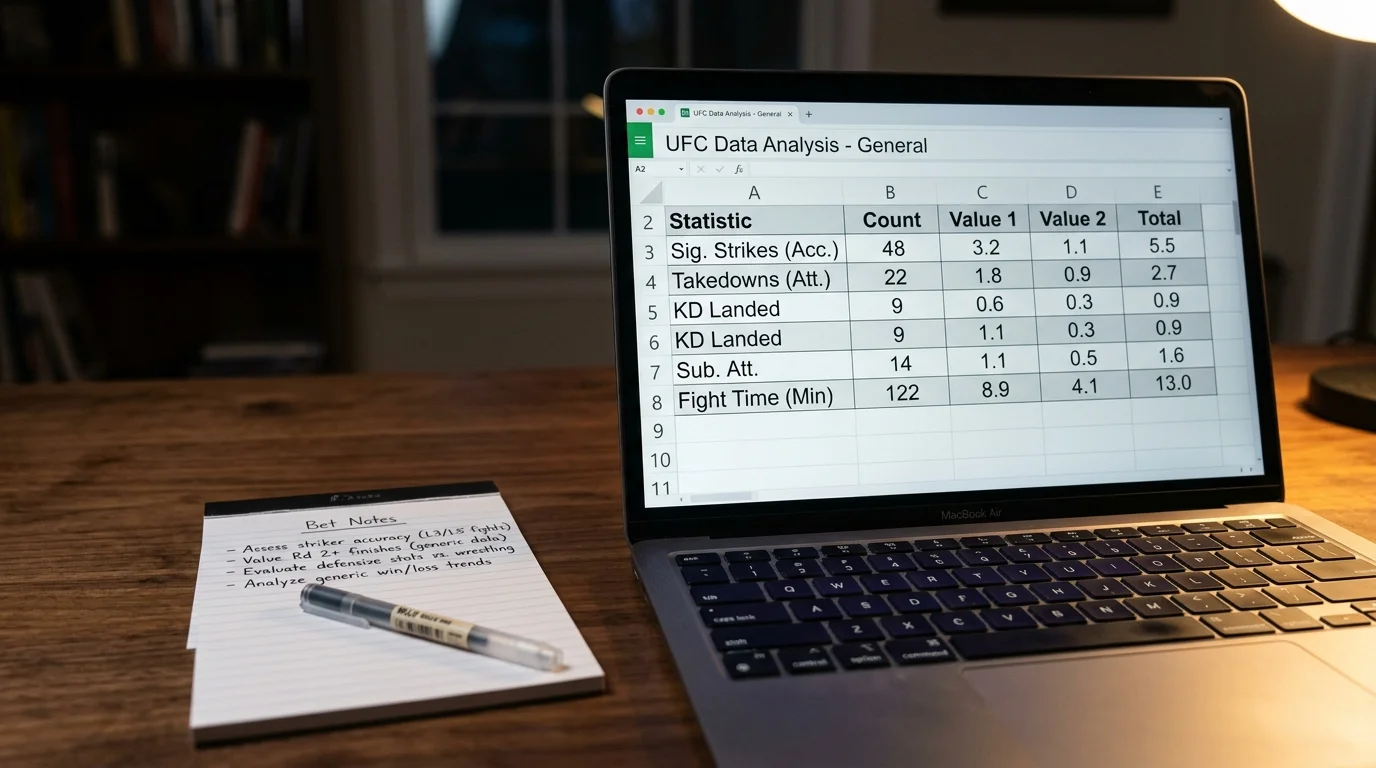
Strategy sets the foundation for pre-fight analysis. But once the cage door closes, a different kind of market opens.
Live UFC Betting: How In-Play Markets Change the Game
I remember the first time I placed an in-play UFC bet — it was during a fight where a heavy favourite had clearly lost the first round and the live line had swung dramatically. The price on the favourite, which had been around 1.30 before the fight, was suddenly 2.20. I backed the favourite, he came out in round two with a different game plan, and won by TKO ninety seconds later. That moment crystallised something for me: the pre-fight market prices what people expect to happen; the live market prices what is actually happening. They are fundamentally different games.
UFC President Dana White said it plainly when the UFC Event Centre launched: "We have the most passionate, diehard fans of any sport, and they're going to love the option to place bets live during a fight. Betting operators are also going to love this product because, unlike other sports, UFC has no off season." He was selling the product, of course, but the underlying claim about engagement has proven accurate. More than a quarter of UK online gamblers have placed in-play bets, with the 25-34 age group — UFC's core demographic — leading adoption.
The UFC Event Centre, originally built by IMG Arena, delivers live data in under two seconds and tracks over 50 real-time statistics during each bout — from significant strikes landed to takedown success rate to control time. This data feeds directly into bookmaker odds engines, enabling the kind of rapid in-play price adjustments that make live UFC betting possible.

The range of live markets has expanded substantially. Where once you could only bet on the outright winner between rounds, sportsbooks partnered with data providers like Sportradar now offer micro-markets: over/under significant strikes, whether a takedown will be scored, and round-winner bets that settle every five minutes. Eduard Blonk, Sportradar's Chief Commercial Officer, described the addition of official UFC data as a way to "unlock more dynamic in-play betting opportunities" — and the product has delivered.
Bet365 reportedly generates more than three-quarters of its total betting turnover from in-play wagering across all sports. UFC's non-stop action and round-based structure make it one of the most natural in-play products on any sportsbook's shelf.
The risk profile of live betting is different from pre-fight. Prices move fast, emotional decision-making is amplified when you are watching a fight in real time, and the margin on live markets tends to be wider than on pre-fight lines because bookmakers are pricing uncertainty more aggressively. I cover timing tactics, round-by-round approaches, and which UK operators offer the strongest live UFC product in my complete guide to live betting on UFC.
Speed and engagement make live UFC betting compelling. But there is a harder question lurking behind the excitement — one that most betting guides ignore entirely.
Betting Integrity in MMA: What UK Punters Should Know
No other top-ten result for "bet on UFC fights UK" mentions the word integrity. Not one. That silence is not a coincidence — affiliate sites earn commissions when you sign up and bet, so the incentive to discuss anything that might make you hesitate is precisely zero. I am not trying to scare you off UFC betting. I am trying to make you a more informed participant in a market where the risks extend beyond picking the wrong fighter.
The International Betting Integrity Association (IBIA) recorded 300 suspicious betting alerts across all sports in 2025 — a 29% increase on the previous year — with 54 matches confirmed as compromised. IBIA's CEO, Khalid Ali, stated that "as markets expand, so too must cooperation between operators, regulators and sports bodies. Data-led monitoring and cross-sector collaboration are not optional; they are essential to safeguarding sport and maintaining consumer trust." MMA has not been exempt from this trend. In IBIA's Q1 2026 report, MMA was the only sport outside the established majors to receive an alert in North America.
What happened at UFC Vegas 110: In November 2025, fighter Isaac Dulgarian was released by the UFC after a suspicious loss. The betting line on his fight shifted from -250 to -154 in the hours before the bout — a dramatic and unusual swing. Caesars Sportsbook voided and refunded bets on the fight. The incident remains one of the most publicly visible integrity cases in recent UFC history.
A separate case at UFC 324 in January 2026 saw a bout between Hernandez and Johnson cancelled outright because of irregular betting activity — confirmed publicly by Dana White himself. And reporting throughout 2025 indicated that the FBI had flagged over 100 UFC fights that year for review of anomalous wagering patterns.
Structural vulnerability: UFC fighters receive an estimated 16-20% of the organisation's revenue, compared to approximately 50% in the NBA, NFL, and NHL. When a fighter on the undercard earns a few thousand dollars per bout, a coordinated betting operation can generate multiples of that purse. One widely cited analysis summarised the problem: a single participant determines the outcome, most fighters earn low pay, and a bet is often worth more than a purse.
TKO Group Holdings' president Mark Shapiro has pushed back, stating that UFC "works with an independent betting integrity service, IC360, to monitor wagering activity on every UFC event, and took immediate action in both instances" — referring to the Dulgarian and UFC 324 cases. The organisation's position is that these are isolated incidents in a sport that hosts nearly 500 fights annually.
As a bettor, your takeaway is awareness, not paranoia. Watch for unusual line movements before a fight — a swing of 100+ points on an undercard bout with no injury news is a red flag. Be cautious with fighters whose purses are small enough that external incentives could outweigh competitive ones. The monitoring systems exist and are improving, but the speed of MMA betting expansion has outpaced regulatory infrastructure. I cover the IBIA alert system, IC360's role, and fighter pay dynamics in detail in my piece on UFC betting integrity.
Responsible Gambling: Tools and Limits That Matter
I have a rule I follow without exception: if I catch myself calculating how much I need to win back from the last card, I close the app and do not open it again until the next event. That rule has protected my bankroll more than any staking plan or analytical model ever has. UFC betting is exciting precisely because it is fast, visceral, and emotionally engaging — which is exactly what makes it dangerous for anyone whose relationship with gambling becomes compulsive rather than recreational.
The data paints a stark picture. Research published in The Lancet Public Health found that 37% of men aged 18-24 who had attempted suicide within the preceding year showed signs of problem gambling, with the adjusted odds ratio for men reaching 9.0. That statistic is not buried in an obscure journal; it is one of the most significant findings in UK gambling harm research of the past decade. UFC's audience — young, predominantly male, highly engaged — sits squarely within the demographic most vulnerable to gambling-related harm.
If betting stops being fun, it has stopped being recreational. The moment you are chasing losses, lying about how much you wager, or feeling anxious about your betting activity, you are experiencing signs of problem gambling. This is not a weakness — it is a recognised pattern, and support is available.
More than a quarter of UK online gamblers have placed in-play bets — the fastest, most immersive form of wagering. UFC's round-by-round intensity amplifies the "just one more bet" impulse. Recognising this means using the tools your sportsbook is legally required to provide.
Every UKGC-licensed sportsbook must offer: deposit limits (daily, weekly, monthly), loss limits, session time limits, reality checks (pop-up reminders of how long you have been active), cooling-off periods (24 hours to 6 weeks), and self-exclusion (minimum 6 months via the operator or via GAMSTOP for a national multi-operator block). These are not optional features — the Gambling Commission mandates them. Use at least one. Set a deposit limit before your first UFC card, and review it quarterly.
I am not going to pretend that a paragraph in a betting guide will prevent gambling harm. But I will say this: in nine years of analysing UFC odds, the bettors I have seen sustain long-term engagement with the sport are invariably the ones who treat it as an intellectual exercise with a financial component, not the other way around. If you want help, the National Gambling Helpline operates 24/7 on freephone 0808 8020 133, and GamCare offers free counselling and practical support. There is no shame in using them — only in pretending the risk does not exist.
Frequently Asked Questions About UFC Betting in the UK
Is it legal to bet on UFC fights in the UK?
Yes. UFC betting is fully legal under the Gambling Act 2005, regulated by the UK Gambling Commission. Any sportsbook offering UFC markets to UK customers must hold a valid UKGC licence, which you can verify on the Commission's public register. There is no separate combat sports category — UFC is regulated identically to football or horse racing. You must be 18 or older to bet.
What types of bets can you place on UFC fights?
The most common UFC markets at UK sportsbooks are moneyline (picking the winner), method of victory (KO/TKO, submission, or decision), over/under rounds, exact round betting, and same-game parlays combining multiple selections from one fight. Advanced platforms also offer fighter-level props such as total significant strikes or takedown counts. Market depth varies — some operators price the full card, others focus on the main event and co-main.
How do UFC betting odds work in fractional format?
Fractional odds show profit relative to stake. A price of 5/2 means £5 profit for every £2 wagered, plus your stake back — £7 total return. When a fighter is heavily favoured, you see fractions like 1/4: risk £4 to win £1 profit. The left number is always the potential profit; the right number is always the stake. To find implied probability, divide the right number by the sum of both: for 5/2, that is 2/(5+2) = 28.6%.
Can you bet on UFC fights live during the event?
Yes. Most major UK sportsbooks offer in-play UFC betting with odds updating between rounds and, at some operators, within rounds. Live markets include the fight winner, round betting, method of victory, and — at select platforms — micro-markets on strikes and takedowns. Margins on live lines tend to be wider than pre-fight prices, and odds move fast, so live betting carries a different risk profile. Cash-out is available at some operators.
How do UFC parlays and bet builders work?
A UFC parlay (bet builder or same-game parlay) combines multiple selections from one fight into a single wager — for example, Fighter A to win by KO/TKO and the fight to go under 2.5 rounds. All legs must win for the bet to pay out. Bookmakers restrict highly correlated combinations, and the margin compounds across every leg, so the effective house edge on a three-leg parlay is significantly higher than on any single bet.
What is method of victory betting in UFC?
Method of victory betting asks you to predict how the fight ends: KO/TKO (referee stoppage due to strikes), submission (tap-out via choke or joint lock), or decision (judges' scorecards after the full distance). Some sportsbooks combine method with a specific fighter — Fighter A by submission, for instance. Prices are longer than moneyline odds because you are predicting a more specific outcome, but the returns are better when divisional finish-rate data supports your selection.
What percentage of UFC favourites actually win?
In 2024, favourites won approximately 72% of UFC bouts. That does not make them automatically profitable — the odds already price in that win rate. A fighter at -250 (implied 71.4%) needs to win more than 71.4% of the time just to break even at that price. Historical data shows lines between -400 and -900 predict correctly 88-93% of the time, but lines in the -100 to -122 range are accurate only about 51%. Profitability depends on the price, not the headline win rate.
Created by the ”bet on ufc Fights” editorial team.